
When the Blair government introduced the National Minimum Wage in 1999, the risks of doing so were well known. Parliament accepts that raising the price of something reduces demand for it – that is why it imposes high taxes on tobacco and alcohol. There was also the prominent North-South divide, later used to justify HS2, and with it the obvious risk that a national rate would be too high for some parts of the country and too low for others.
Despite the warnings, Parliament went ahead, establishing the Low Pay Commission to set a rate that would avoid damaging employment.
The knowledge needed to make such a decision is not merely incomplete at the centre – it is dispersed across millions of individuals, each possessing local knowledge no central body can replicate. A café owner in Sudbury knows what his customers will pay for a coffee, and therefore what he can afford to pay his staff. That knowledge is his alone. The Commission, to its credit, acknowledges in its recent report that evidential gaps exist.
Initially the Commission appeared to achieve the impossible: there was little discernible effect on employment. But the rate had been set at a very low level, and few employees were paid it. Today it is common for more than half of a company’s workforce to have their pay set by an unelected quango with no knowledge of the business, its profitability or the performance of individual staff.
Alan Milburn recently reported that employers are reluctant to take on young people because of the cost. Since 2019 the rate for 18-to-20-year-olds has risen 76 per cent, and for 21-to-24-year-olds 65 per cent.
The minimum wage is also responsible for secondary effects. Employers are forced to give senior staff the same above-inflation increases simply to maintain differentials. In other cases, bosses and experienced workers go without a pay rise to fund increases for those they train. Poorer regions, meanwhile, cannot compete on labour costs – their one natural advantage has been legislated away. And, unsurprisingly, where all low-paid jobs carry the same rate, workers gravitate to the agreeable ones and the unpleasant ones go unfilled.
When problems arise, there is no correction mechanism. It is politically impossible for any government to cut the minimum wage. Instead, the Government has tightened the inspection regime since April, with fines of 200 per cent of any underpayment. HMRC, which routinely overtaxes employees, faces no such sanction – even though the employee is just as short-changed.
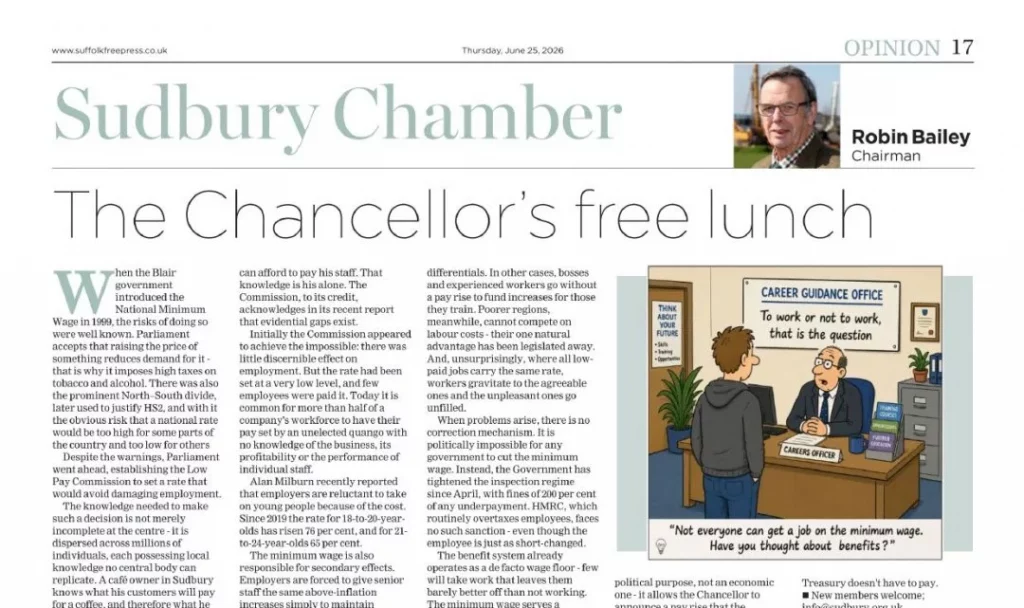
The benefit system already operates as a de facto wage floor – few will take work that leaves them barely better off than not working. The minimum wage serves a political purpose, not an economic one – it allows the Chancellor to announce a pay rise that the Treasury doesn’t have to pay.
New members welcome – ku.gro.yrubdus@ofni
