
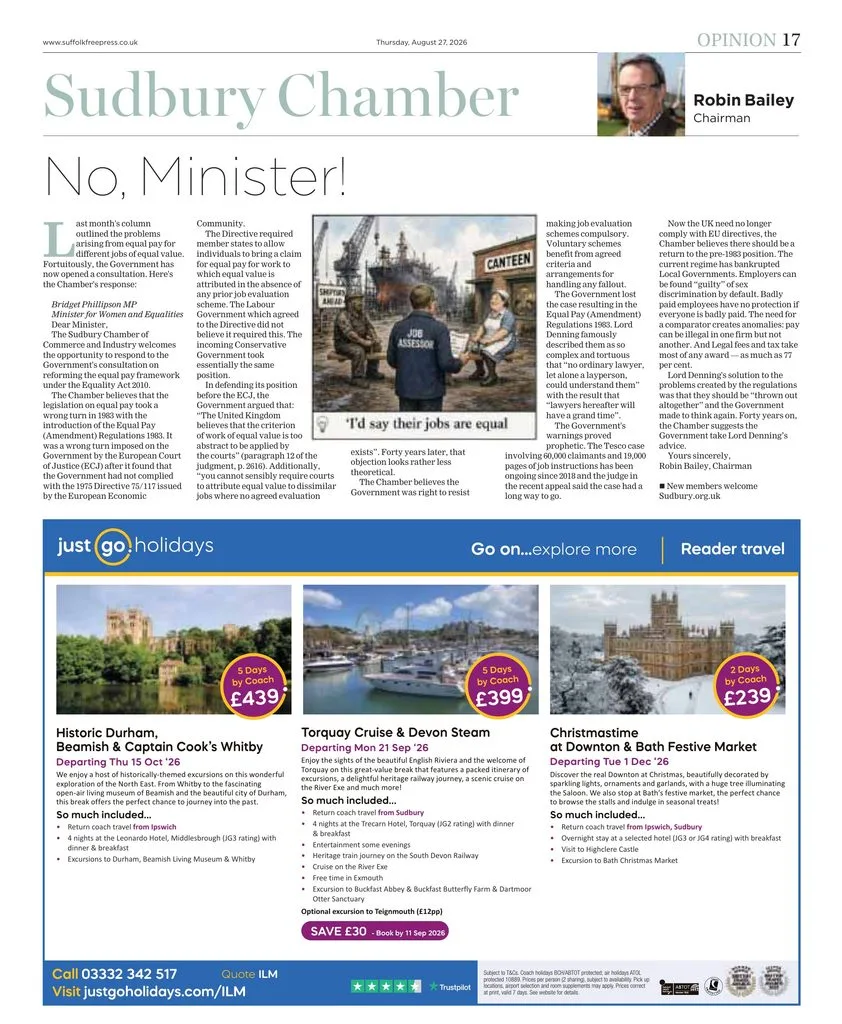
Last month’s column outlined the problems arising from equal pay for different jobs of equal value. Fortuitously, the Government has now opened a consultation. Here’s the Chamber’s response:
Bridget Phillipson MP
Minister for Women and Equalities
Dear Minister,
The Sudbury Chamber of Commerce and Industry welcomes the opportunity to respond to the Government’s consultation on reforming the equal pay framework under the Equality Act 2010.
The Chamber believes that the legislation on equal pay took a wrong turn in 1983 with the introduction of the Equal Pay (Amendment) Regulations 1983. It was a wrong turn imposed on the Government by the European Court of Justice (ECJ) after it found that the Government had not complied with the 1975 Directive 75/117 issued by the European Economic Community.
The Directive required member states to allow individuals to bring a claim for equal pay for work to which equal value is attributed in the absence of any prior job evaluation scheme. The Labour Government which agreed to the Directive did not believe it required this. The incoming Conservative Government took essentially the same position.
In defending its position before the ECJ, the Government argued that: “The United Kingdom believes that the criterion of work of equal value is too abstract to be applied by the courts” (paragraph 12 of the judgment, p. 2616). Additionally, “you cannot sensibly require courts to attribute equal value to dissimilar jobs where no agreed evaluation exists”. Forty years later, that objection looks rather less theoretical.
The Chamber believes the Government was right to resist making job evaluation schemes compulsory. Voluntary schemes benefit from agreed criteria and arrangements for handling any fallout.
The Government lost the case resulting in the Equal Pay (Amendment) Regulations 1983. Lord Denning famously described them as so complex and tortuous that “no ordinary lawyer, let alone a layperson, could understand them” with the result that “lawyers hereafter will have a grand time”.
The Government’s warnings proved prophetic. The Tesco case involving 60,000 claimants and 19,000 pages of job instructions has been ongoing since 2018 and the judge in the recent appeal said the case had a long way to go.
Now the UK need no longer comply with EU directives, the Chamber believes there should be a return to the pre-1983 position. The current regime has bankrupted Local Governments. Employers can be found “guilty” of sex discrimination by default. Badly paid employees have no protection if everyone is badly paid. The need for a comparator creates anomalies: pay can be illegal in one firm but not another. And Legal fees and tax take most of any award — as much as 77 per cent.
Lord Denning’s solution to the problems created by the regulations was that they should be “thrown out altogether” and the Government made to think again. Forty years on, the Chamber suggests the Government take Lord Denning’s advice.
New members welcome Sudbury.org.uk
Yours sincerely,
Robin Bailey
Chairman
