
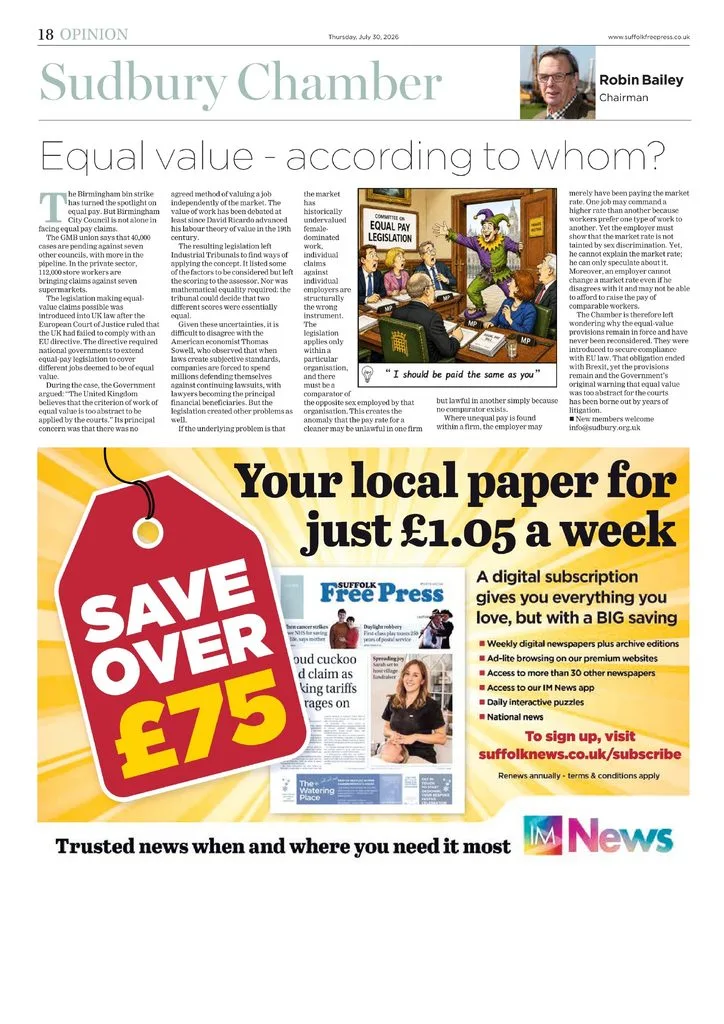
The Birmingham bin strike has turned the spotlight on equal pay. But Birmingham City Council is not alone in facing equal pay claims.
The GMB union says that 40,000 cases are pending against seven other councils, with more in the pipeline. In the private sector, 112,000 store workers are bringing claims against seven supermarkets.
The legislation making equal-value claims possible was introduced into UK law after the European Court of Justice ruled that the UK had failed to comply with an EU directive. The directive required national governments to extend equal-pay legislation to cover different jobs deemed to be of equal value.
During the case, the Government argued: “The United Kingdom believes that the criterion of work of equal value is too abstract to be applied by the courts.” Its principal concern was that there was no agreed method of valuing a job independently of the market. The value of work has been debated at least since David Ricardo advanced his labour theory of value in the 19th century.
The resulting legislation left Industrial Tribunals to find ways of applying the concept. It listed some of the factors to be considered but left the scoring to the assessor. Nor was mathematical equality required: the tribunal could decide that two different scores were essentially equal.
Given these uncertainties, it is difficult to disagree with the American economist Thomas Sowell, who observed that when laws create subjective standards, companies are forced to spend millions defending themselves against continuing lawsuits, with lawyers becoming the principal financial beneficiaries. But the legislation created other problems as well.
If the underlying problem is that the market has historically undervalued female-dominated work, individual claims against individual employers are structurally the wrong instrument. The legislation applies only within a particular organisation, and there must be a comparator of the opposite sex employed by that organisation. This creates the anomaly that the pay rate for a cleaner may be unlawful in one firm but lawful in another simply because no comparator exists.
Where unequal pay is found within a firm, the employer may merely have been paying the market rate. One job may command a higher rate than another because workers prefer one type of work to another. Yet the employer must show that the market rate is not tainted by sex discrimination. Yet, he cannot explain the market rate; he can only speculate about it. Moreover, an employer cannot change a market rate even if he disagrees with it and may not be able to afford to raise the pay of comparable workers.
The Chamber is therefore left wondering why the equal-value provisions remain in force and have never been reconsidered. They were introduced to secure compliance with EU law. That obligation ended with Brexit, yet the provisions remain and the Government’s original warning that equal value was too abstract for the courts has been borne out by years of litigation.
New members welcome ku.gro.yrubdus@ofni
